
Every year, thousands of students across Multan begin their Matric journey with confidence and high expectations. They buy new textbooks, attend school regularly, and promise themselves that this year will be different. Yet when the Punjab Board results are announced, many students are disappointed to see marks that don’t reflect the effort they believed they had put in.
For parents, the results often raise difficult questions. Did my child study enough? Should we have sought extra academic support earlier? What can we do differently next year? Students ask similar questions, wondering why classmates with similar abilities performed better.
The reality is that most students do not fail because they lack intelligence. More often, they struggle because of ineffective study habits, inconsistent revision, poor time management, exam anxiety, or relying on last-minute preparation. These challenges are common, but they are also preventable.
Understanding Why Most Multan Students Fail Matric is the first step toward improving academic performance. Once students recognize the habits holding them back, they can replace them with practical strategies that build confidence, strengthen concepts, and lead to better results.
Whether you’re preparing for your first Punjab Board examination or you’re a parent looking for ways to support your child, this guide provides practical, experience-based advice that can help students study smarter—not just harder.
Table of Contents
Key Takeaways
Before diving into the details, here are the most important lessons from this guide:
- Most students struggle because of study habits—not because they lack ability.
- Consistent revision is more effective than last-minute cramming.
- Understanding concepts leads to better marks than memorizing answers.
- Solving past papers improves confidence and exam performance.
- A realistic study timetable helps students stay organized throughout the year.
- Parents play a vital role by encouraging healthy routines and positive learning habits.
- Seeking academic support early can help students overcome weak subjects before they become major obstacles.
Why Many Multan Students Struggle in Matric
Failing a Matric examination is rarely caused by one major mistake. In most cases, it’s the result of several small habits that gradually affect a student’s preparation throughout the academic year.
Many students enter Class 9 and Class 10 using the same study methods they relied on in middle school. While those techniques may have worked previously, Matric examinations require a deeper understanding of concepts, stronger writing skills, and better time management.
Several factors contribute to lower marks, including:
- Studying only a few weeks before examinations.
- Memorizing answers without understanding concepts.
- Ignoring difficult subjects until the last minute.
- Spending excessive time on mobile phones or social media.
- Not solving past papers regularly.
- Weak study planning and inconsistent revision.
- Feeling hesitant to ask teachers questions.
- Lack of personalized academic guidance.
These challenges are not unique to Multan—they affect students across Pakistan. However, recognizing them early allows students to make meaningful improvements long before board examinations begin.
Common Mistakes Matric Students Make
Many students unknowingly repeat the same mistakes every year. Avoiding these common habits can significantly improve both confidence and academic performance.
Waiting Until the Final Weeks
One of the biggest reasons students struggle is delaying serious preparation until exams are only a few weeks away.
The Punjab Board syllabus covers a wide range of topics, making it difficult to revise everything effectively in a short period. Instead of depending on marathon study sessions, successful students revise each chapter throughout the year.
Small, regular study sessions are far more effective than trying to learn everything at once.
Memorizing Instead of Understanding
Rote learning may help students remember definitions, but it often fails when examinations include conceptual or analytical questions.
Subjects such as Mathematics, Physics, Chemistry, and Biology require students to understand why something works—not just what the textbook says.
When students understand concepts, they can answer unfamiliar questions with greater confidence.
Ignoring Weak Subjects
It’s natural to spend more time studying favourite subjects, but avoiding difficult topics usually leads to disappointing results.
For example, a student who enjoys Biology may continue practising it while postponing Mathematics because it feels challenging. Over time, that gap becomes harder to close.
Successful students dedicate additional time to subjects they find difficult rather than avoiding them.
Depending Only on Guess Papers
Guess papers can be useful during the final revision stage, but they should never replace textbooks, classroom notes, and past paper practice.
Students who rely only on expected questions often struggle when the board examination includes new question patterns or application-based problems.
A balanced preparation strategy includes:
- Punjab Board textbooks
- Class notes
- Chapter-wise revision
- Past papers
- Self-assessment tests
Poor Time Management
Many students spend hours sitting at a study table without completing meaningful work.
Checking social media every few minutes, studying without a clear objective, or switching repeatedly between subjects reduces concentration and productivity.
A simple study plan with achievable daily goals helps students remain focused and track their progress throughout the academic year.
How to Pass Matric Exams – A Practical Roadmap
Students often search online for how to pass Matric exams, hoping to find a shortcut to success. While there is no single formula, there are proven habits that consistently help students perform better in board examinations.
1. Know the Syllabus
Start by understanding what each subject covers. Create a checklist of chapters and monitor your progress throughout the year. This helps you identify topics that need additional attention before examination season begins.
2. Set Weekly Goals
Instead of trying to complete multiple chapters in one day, set realistic weekly targets.
For example:
- Complete one Mathematics chapter.
- Revise two Biology chapters.
- Solve one English past paper.
- Review important Chemistry reactions.
Achievable goals build momentum and reduce the stress that comes from unrealistic expectations.
3. Practice Writing Answers
Reading alone is not enough for Punjab Board examinations.
Students should regularly:
- Solve numerical problems.
- Write long-answer questions.
- Practice labelled diagrams.
- Attempt full past papers under timed conditions.
Writing improves speed, presentation, and confidence during the actual examination.
4. Revise Consistently
Revision is most effective when spread throughout the academic year.
A simple revision cycle works well for many students:
- Review a lesson within 24 hours.
- Revise it again after one week.
- Revisit it after one month.
This method strengthens long-term memory and reduces the need for last-minute cramming.
Sample Study Schedule for Matric Students
One of the easiest ways to improve academic performance is to follow a structured study routine. A timetable doesn’t have to be perfect—it simply needs to be realistic and consistent.
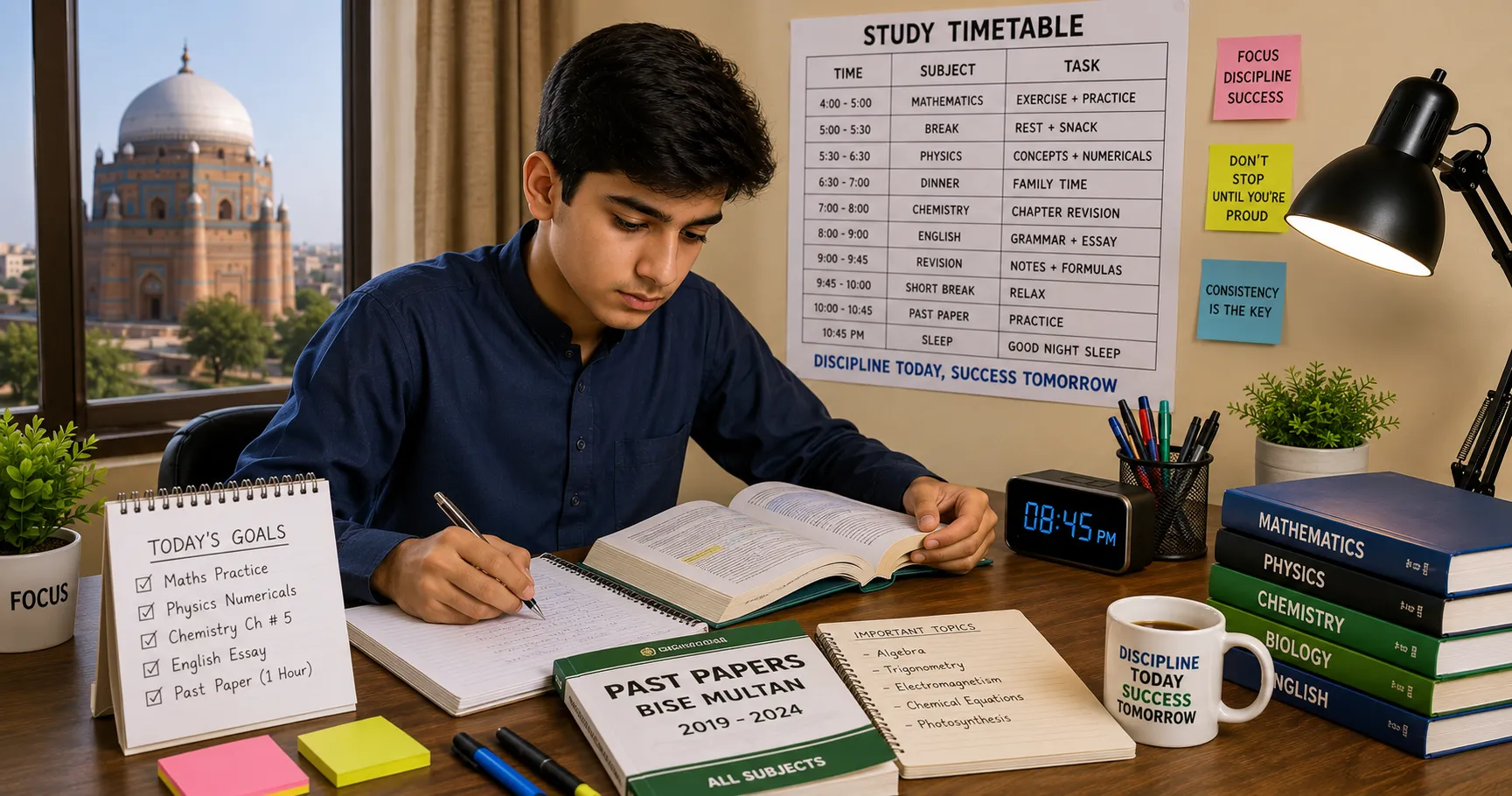
| Time | Activity |
|---|---|
| 4:00–4:30 PM | Rest after school |
| 4:30–5:45 PM | Mathematics or Science |
| 5:45–6:00 PM | Short break |
| 6:00–7:00 PM | English or Urdu |
| 7:00–8:00 PM | Dinner and family time |
| 8:00–9:15 PM | Homework and revision |
| 9:15–9:30 PM | Plan tomorrow’s study goals |
| 10:00 PM | Sleep |
This schedule is only a starting point. Students should adjust it according to their school timings, tuition classes, and personal commitments. The most important factor is consistency—studying a little every day is far more effective than relying on last-minute preparation.
Subject-Wise Study Tips for Better Matric Results
Every Matric subject requires a different approach. Understanding how to study each subject effectively can save time and improve your overall performance.
Mathematics
Mathematics is one of the subjects where regular practice makes the biggest difference.
To improve your marks:
- Solve numerical questions every day.
- Understand formulas instead of memorizing steps.
- Review mistakes after each practice session.
- Attempt past paper questions regularly.
Even 30–45 minutes of focused practice can significantly strengthen your problem-solving skills.
Physics
Physics becomes easier when concepts are understood before solving numerical problems.
Focus on:
- Learning formulas with their applications.
- Practising numerical questions.
- Drawing neat diagrams.
- Reviewing important definitions and laws.
Understanding the “why” behind each concept helps students answer unfamiliar questions with confidence.
Chemistry
Chemistry combines theory, equations, and practical understanding.
Students should:
- Create chapter summaries.
- Practice balancing chemical equations.
- Learn reactions step by step.
- Revise formulas regularly.
Using flashcards can also help with remembering scientific terms and chemical reactions.
Biology
Biology requires both understanding and memorization.
Effective strategies include:
- Drawing labelled diagrams by hand.
- Making concise chapter notes.
- Revising scientific terminology.
- Explaining concepts in your own words.
Visual learning techniques often improve long-term retention.
English & Urdu
Language subjects require consistent reading and writing practice.
Students should:
- Read passages daily.
- Practice essay and letter writing.
- Improve grammar gradually.
- Focus on neat handwriting and answer presentation.
Strong writing skills often lead to higher marks in descriptive subjects.
Time Management Tips for Matric Students
One of the common mistakes Matric students make is confusing long study hours with productive study.
Success depends more on focused learning than on the number of hours spent at a desk.
Here are a few practical strategies:
- Study difficult subjects when your concentration is highest.
- Use 45–60 minute focused study sessions followed by short breaks.
- Keep your mobile phone away during study time.
- Review completed work at the end of each week.
- Track your progress using a notebook or study planner.
Remember, consistency beats intensity. A few focused hours every day are usually more effective than studying all night before an exam.
A Parent’s Guide to Supporting Matric Students
Parents play an important role in helping students stay motivated throughout the academic year.
Simple actions at home can have a positive impact on academic performance.

Encourage Healthy Study Habits
Help your child establish a consistent daily routine that includes study time, meals, rest, and adequate sleep.
Create a Positive Learning Environment
Provide a quiet space where your child can study without unnecessary distractions.
Focus on Progress, Not Just Marks
Celebrate improvements in effort and understanding rather than only expecting perfect grades.
Positive encouragement builds confidence and reduces exam-related stress.
Stay Involved
Ask about your child’s progress, schoolwork, and any subjects they find difficult.
Early conversations often identify problems before they become major academic challenges.
Benefits of Good Matric Preparation
Students who prepare consistently throughout the year often experience benefits beyond examination results.
These include:
- Better understanding of core concepts.
- Increased confidence during exams.
- Improved time management skills.
- Reduced examination stress.
- Stronger academic foundation for FSc, ICS, ICom, and other higher studies.
- Greater self-discipline and independent learning skills.
Good preparation is not just about passing exams—it helps students develop habits that support lifelong learning.
Common Challenges and Practical Solutions
Every student faces obstacles during Matric preparation. The key is knowing how to overcome them.
| Challenge | Practical Solution |
|---|---|
| Weak Mathematics concepts | Practice daily and seek concept-based guidance. |
| Difficulty remembering lessons | Revise weekly using short notes. |
| Exam anxiety | Solve timed past papers to build confidence. |
| Poor concentration | Study in focused sessions with regular breaks. |
| Mobile phone distractions | Set screen-time limits during study hours. |
| Falling behind in Science subjects | Ask for help early instead of delaying difficult topics. |
Academic challenges are normal. What matters most is taking action before they affect examination performance.
When Should You Consider a Home Tutor?
Not every student requires extra tuition, but personalized academic support can be helpful in certain situations.
Consider additional guidance if a student:
- Consistently struggles in one or more subjects.
- Finds it difficult to understand classroom lessons.
- Receives declining test scores.
- Lacks confidence before examinations.
- Needs individual attention that may not always be available in a classroom.

For many families, home tuition in Multan provides the opportunity for one-to-one learning, while an online tutor in Pakistan offers flexibility for students who prefer remote learning.
The right tutor should strengthen concepts, encourage independent learning, and adapt lessons to the student’s pace—not simply complete the syllabus.
Why Choose PakAider?
Finding the right tutor should be simple, transparent, and focused on the student’s individual needs.
PakAider helps connect students with qualified tutors for:
- Home tuition in Multan and other cities.
- Online tutoring across Pakistan.
- Matric, FSc, ICS, ICom, O Level, and A Level subjects.
- Science, Mathematics, English, Computer Science, Commerce, and more.
- Flexible learning based on the student’s schedule and goals.
Whether you’re looking for the best home tutor in Multan or an experienced online teacher, PakAider makes it easier to find academic support that matches your requirements.
Frequently Asked Questions
Why do many students fail Matric exams?
Most students struggle because of inconsistent study habits, poor time management, weak conceptual understanding, and delaying preparation until the final weeks before examinations.
How can I improve my Matric result?
Follow a structured study timetable, revise lessons regularly, solve past papers, focus on weak subjects, and seek help whenever concepts are unclear.
Is home tuition better than academy classes?
It depends on the student’s learning style. Home tuition provides personalized attention, while academies may suit students who enjoy learning in groups.
How many hours should a Matric student study every day?
Most students benefit from two to four hours of focused self-study outside school, depending on their academic needs and examination schedule.
Can online tutoring help Punjab Board students?
Yes. Online tutoring provides flexible access to experienced teachers and can be an effective option for students who need additional academic support from home.
Conclusion
Understanding Why Most Multan Students Fail Matric isn’t about pointing out weaknesses—it’s about identifying the habits that prevent students from reaching their full potential.
Academic success doesn’t depend on studying longer hours or relying on guess papers. It comes from consistent revision, strong conceptual learning, effective time management, and the willingness to ask for help when needed.
For parents, supporting a child through Matric means creating a positive learning environment, encouraging healthy study habits, and recognizing when additional guidance may be beneficial.
For students, remember that every chapter you complete, every past paper you solve, and every question you ask moves you closer to your goals. Small improvements made consistently throughout the year often lead to remarkable results on examination day.
If you’re looking for reliable academic support, PakAider can help you connect with qualified home and online tutors across Pakistan—making it easier to learn with confidence and prepare for success.

Israr Ahmed is the founder of PakAider and a digital publisher focused on education, student development, and learning opportunities in Pakistan. He creates research-based content covering home tuition, online learning, scholarships, educational initiatives, digital skills, and student support programs. His goal is to connect learners with reliable information, quality educational resources, and practical guidance that supports academic success and lifelong learning.